
EV battery lifespan: wear, warranty, replacement
It's one of the most common concerns among prospective EV buyers: will the battery hold up over time? Here's what the data available in 2026 shows, and how to limit wear day to day.
Gradual wear, not a sudden failure
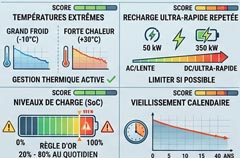
Contrary to a common misconception, an EV battery doesn't suddenly "give out". Its wear shows up as a gradual decline in capacity, typically around 2% to 3% per year. After 160,000km, most batteries still retain more than 90% of their original capacity. On the most recent technologies, a lifespan of 10 to 15 years, or roughly 500,000km, is a realistic ballpark figure.
What the manufacturer warranty covers
Most manufacturers warranty their battery for 8 years or 160,000km, committing to repair or replace it if capacity falls below a threshold generally set between 60% and 70% of original capacity. Exact terms vary by brand — check your vehicle's before buying.
How much does a replacement cost?
A full battery replacement remains a costly operation: generally between €4,500 and €19,000 depending on the model and capacity — thankfully a rare occurrence given current warranties and how slowly wear actually progresses.
How to preserve your battery day to day
- Favour slow charging (AC) over fast charging (DC) for everyday use — it generates far less heat, a key factor in chemical wear.
- Charge between 20% and 80% day to day rather than systematically aiming for 100%.
- Save fast charging for long trips, keeping in mind that occasional use has no significant impact.
- Avoid leaving the vehicle exposed to intense heat for long periods.
This is precisely the charging mode ShareNplug enables: gentle, alternating-current charging at a private individual's near you — the option most respectful of your battery's long-term health.
Learn more about slow vs fast charging →