
Real-world range vs WLTP: why the gap, and how to plan around it
Have you noticed that the range shown on your vehicle's spec sheet never quite matches what you get day to day? That's normal, and well documented: here's why, and how to better plan your trips.
What is the WLTP cycle?
WLTP (Worldwide harmonized Light vehicles Test Procedure) is the standardized European protocol for measuring vehicle energy consumption and range, carried out in a lab under controlled, ideal conditions. It lets you compare models on a common basis — but it's not a promise of real-world mileage.
A 20-40% gap in real-world use
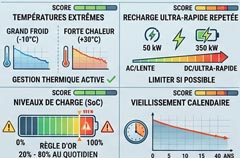
In daily use, real-world range is generally 10% to 20% lower than the WLTP figure, and can drop as much as 20-40% depending on conditions. The main factors behind this gap:
- Motorway speed — driving at a constant 130km/h can use up to twice as much energy as at 90km/h, a real "energy wall" for an EV.
- Cold weather — low temperatures reduce the battery's chemical efficiency and increase cabin heating needs.
- Air conditioning and heating — unlike a combustion engine, an EV has no "free" waste heat to recover.
- Driving style — sharp acceleration and aggressive driving noticeably increase consumption.
- Battery wear — the WLTP figure is calculated on a new battery; after 5 to 8 years, maximum real-world range decreases accordingly.
How to better plan for your real-world range
A reasonable rule of thumb is to plan on 70% to 80% of the WLTP figure for mixed use, and to revise that estimate downward in winter or for frequent motorway driving. For everyday trips, it's better to identify reliable charging points along your route or near your destination in advance rather than relying solely on the range shown at departure.
That's where ShareNplug can make a difference: finding a charger shared by an individual near your workplace or destination means you're not solely dependent on your remaining range buffer.
Find a charging solution near you →