
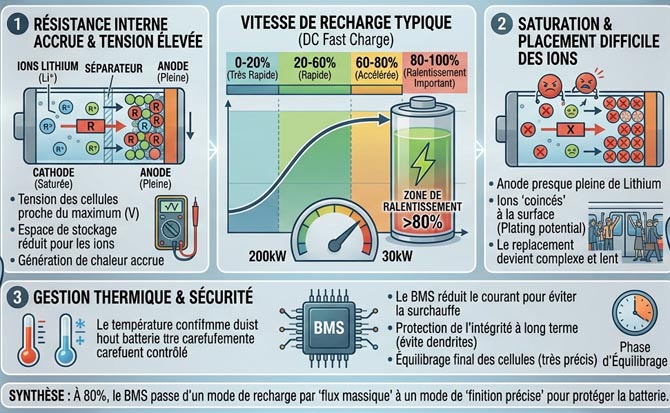
Why does your EV's charging speed slow down after 80%?
You've probably noticed this on a fast charger: the first percentages climb quickly, then charging speed drops noticeably as you approach 80%. It's not a malfunction — it's a deliberate protection mechanism.
The charging curve, in two phases
An EV battery charges in two distinct phases: a constant-current phase, from 0% to around 80%, where power stays high and stable, then a constant-voltage phase, from 80% to 100%, where current gradually decreases. It's this second phase that explains the feeling of slowing down.
In practice, on most mainstream EVs, going from 80% to 100% can take as long — or longer — than going from 0% to 80%. A car can reach 80% in 30 to 40 minutes on a fast charger, then need 40 minutes to over an hour more for the remaining 20%.
Why this slowdown is intentional
It's the vehicle's BMS (Battery Management System) that controls this power reduction, for three reasons: protecting the cells from excessive electrical and thermal stress at the end of charging, improving the installation's overall safety, and preserving the battery's performance over the long term.
What this means for how you charge
On a fast charger (DC), aiming for 80% rather than 100% is nearly always the smarter choice: you save valuable time for a range difference that's often secondary, while going easier on your battery. On a slow charger (AC), like those shared by ShareNplug hosts, that time pressure doesn't exist: an overnight charge reaches 100% without the end-of-charge slowdown creating any practical issue.
Slow vs fast charging: which should you favour? →