
Slow AC vs fast DC charging: what impact on your battery's lifespan?
Slow charging or fast charging: the choice isn't just about time. It's also a direct factor in your battery's longevity. Here's what the available data shows, and why charging at a private individual's has a real technical edge.
Two technologies, two logics
Slow AC (alternating current) charging converts the current via the vehicle's onboard charger before sending it to the battery — that's the principle behind the Easee, Zaptec, Wallbox or V2C chargers shared on ShareNplug. Fast DC (direct current) charging sends current straight to the battery via a converter external to the vehicle, enabling much higher power levels, but at the cost of greater stress on the cells.
The real impact on the battery
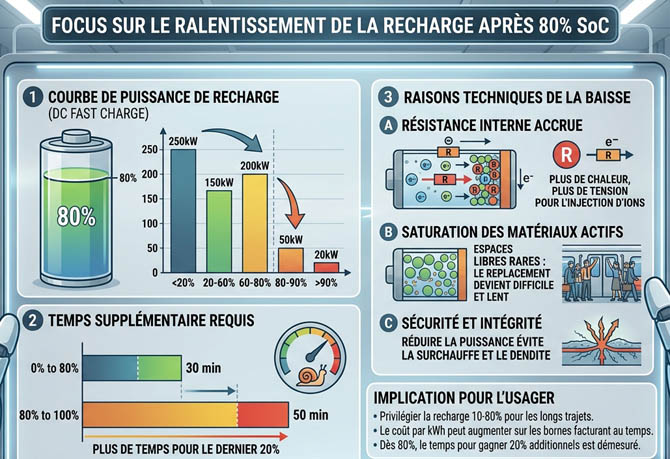
Slow charging is the gentlest mode for the cells: it generates little heat and limits electrochemical stress. Fast charging, by contrast, generates more heat due to the current's intensity, which speeds up the parasitic chemical reactions responsible for premature wear. Occasional fast charging has no catastrophic impact — it's systematic, near-exclusive use that accentuates wear over time.
The 90/10 rule
The recommendation that comes up most often among specialists: reserve fast charging for around 10% of charges (long trips, emergencies), and favour slow AC charging for the remaining 90% — in other words, the bulk of your everyday use, at home, at work, or at a nearby host.
Why ShareNplug ticks this box
This is exactly the model ShareNplug offers: AC chargers shared by individuals, suited to slow, regular charging, without the hassle of finding a free fast charger or the generally higher cost of public DC charging. For your everyday use, it's both the most economical choice and the one most respectful of your battery's long-term health.
Find a slow charger near me →